
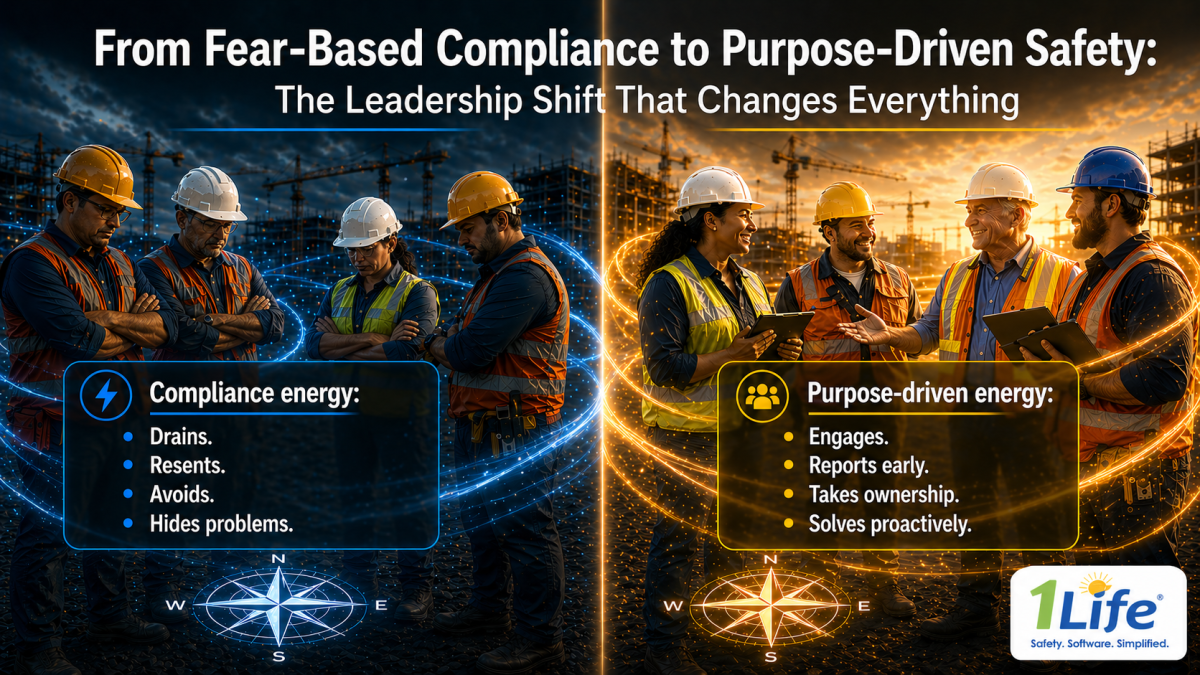
From Fear-Based Compliance to Purpose-Driven Safety: The Leadership Shift That Changes Everything
By Theo Heineman, CRSP, CHSC, CEO, 1Life Workplace Safety Solutions Ltd.
Walk onto two different job sites. On one, you feel it immediately. Tension. Disorganization. People going through the emotions. Rules are followed when someone is watching—but underneath, there’s frustration, pressure, and disengagement.
On the other, the environment feels different. There’s structure, clarity. People are focused, communicating, and working together. Standards aren’t just followed—they’re understood. That difference has very little to do with paperwork. It has everything to do with how safety is being led—and more importantly, how stress is being managed. Most companies are still operating in what can be called compliance-driven safety. The mindset is simple: more rules, more enforcement, more pressure. On the surface, it feels like control. It creates the exact conditions that increase risk.
Because the same environment that creates stress and disengagement is the same environment that drives mistakes, rework, delays, and lost productivity. The same factors that cause safety issues are often the exact same ones that impact quality, production, and overall performance.
In contrast, companies that shift to purpose-driven safety management operate very differently. Instead of asking, “What do we need to do to stay compliant?” they ask, “What are the real risks in our business, and how do we protect our people and our performance?”
They identify their critical tasks—the 20% of the work that generates 80% of the risk. They put clear standards in place. They train those standards consistently. And they enforce them in a way that is visible, fair, and predictable. This structure does more than improve compliance. It reduces stress.
When people know what’s expected, when systems are clear, and when leadership is consistent, the nervous system settles. Workers are no longer operating in fear—they’re operating with clarity and purpose. That shift allows them to engage the part of the brain responsible for decision-making, problem-solving, and communication. The result is measurable:
- better judgment
- stronger teamwork
- more proactive reporting
- higher accountability
- improved performance
And stress, unmanaged, will always show up somewhere—incidents, absenteeism, conflict, or declining productivity. The reality is that most safety problems are not technical problems. They are leadership and system problems. And that’s where the opportunity is.
When leaders make the shift to purpose-driven safety, they are not just improving compliance. They are actively managing the mental and emotional environment of their workforce. They are reducing unnecessary stress, increasing engagement, and creating conditions where people can perform at a higher level.
Technology plays a role here as well. Not as a replacement for leadership, but as a way to reinforce it. Once critical risks are identified, systems like the 1Life safety platform help organizations set, train, and enforce standards consistently across the entire operation. They make expectations visible, track leading indicators, and ensure that corrective actions don’t get lost. In doing so, they remove ambiguity—one of the biggest drivers of workplace stress.
This is especially relevant during Mental Health Week. Mental health in the workplace is often framed as an individual issue. In reality, it is largely driven by the environment leaders create. When that environment is built on fear, pressure, and inconsistency, stress becomes chronic. When it is built on clarity, purpose, and structure, people perform better—and they feel better doing it.
You don’t have to choose between protecting your people and driving performance. The companies that understand this are doing both. Because at the end of the day, safety is not just about compliance.
It’s about creating an environment where people can think clearly, work confidently, and go home safe—physically and mentally.