

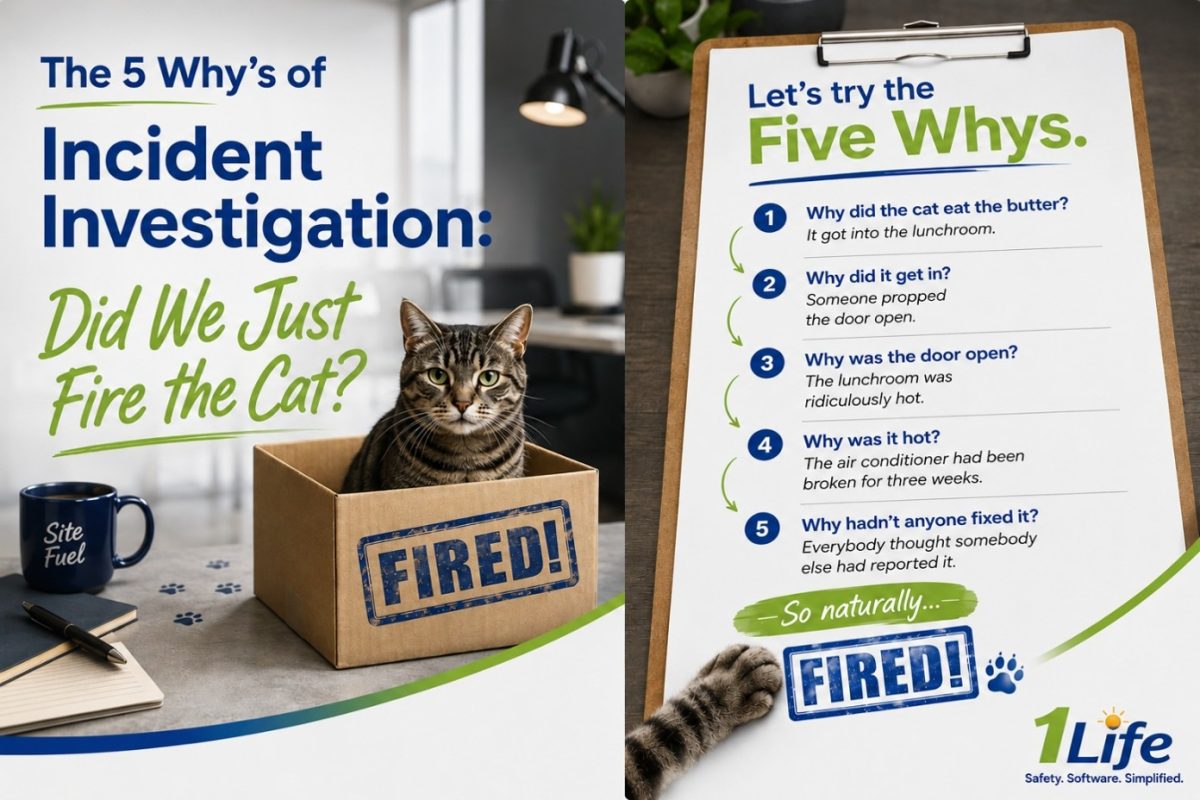
The 5 Why’s of Incident Investigation: Did We Just Fire the Cat?
Monday morning, someone walks into the shop lunchroom and discovers that a cat has eaten the butter off the table. Obviously, we have a cat problem. Or do we?
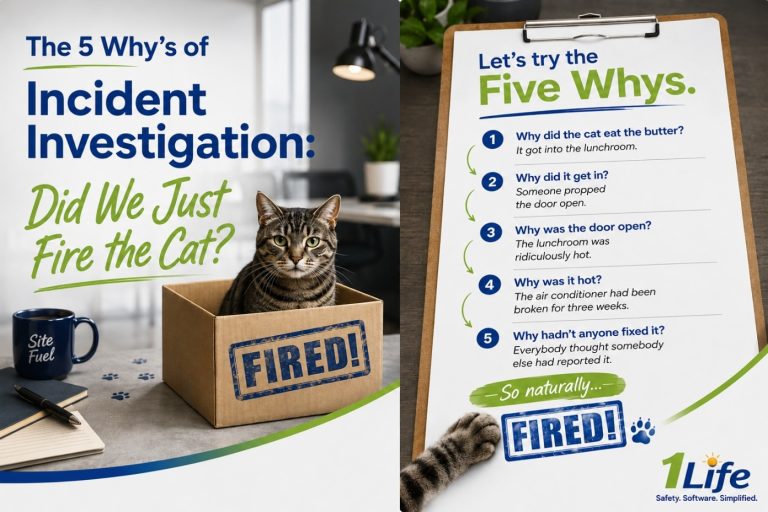
- Why did the cat eat the butter? Because the cat got into the lunchroom.
- Why did the cat get into the lunchroom? Because someone propped the back door open.
- Why was the back door propped open? Because the lunchroom was ridiculously hot.
- Why was the lunchroom ridiculously hot? Because the air conditioner hadn’t been working for three weeks.
- Why hadn’t the air conditioner been fixed? Because everybody thought somebody else had reported it.
So naturally, we fired the cat. Problem solved.
Except the air conditioner is still broken, the door is still propped open—and another cat will probably be eating the butter tomorrow.
It sounds ridiculous, but unfortunately, we do versions of this all the time when investigating workplace incidents.
Don't Stop at the First Answer
A worker falls from a ladder. Why?
He lost his balance. Why?
The ladder wasn’t properly secured. Why?
Although the crew had been trained, the standard wasn’t consistently being reinforced. Why?
The supervisor wasn’t consistently enforcing it. Why?
We weren’t holding our supervisors accountable for enforcing our safety standards.
We started with “the worker fell off the ladder.”
Five questions later, we may have discovered a management system problem.
That’s the value of the Five Whys. We keep asking why until we get beyond what happened and begin to understand why it was allowed to happen.
And there is nothing magical about the number five. Sometimes you’ll get there in three questions. Sometimes you’ll need seven. Sometimes one answer will take you down two or three different paths.
The point is to keep digging until we find something we can actually fix.
Incident Investigation Takes Character
Blaming the worker is easy. He wasn’t paying attention. She should have known better. We trained them. We’ve told them before.
Sometimes individual accountability absolutely is part of the answer. But in my experience, when we honestly investigate incidents, the trail very often leads back to the management system.
Did we have the right standard? Was it clear? Was the worker actually competent to perform the task? Did they have the right equipment? Was the standard reinforced in the field? Was the supervisor enforcing it? Were supervisors being held accountable? And was leadership making sure the system was actually working?
Those aren’t always comfortable questions. It takes character for a company to look honestly at itself rather than defaulting to the easiest answer: the worker screwed up.
Because if we blame the worker when the real problem is the system, we haven’t solved anything. “We’ve just fired the cat.”
And this isn’t only about safety. The Five Whys can be incredibly useful for recurring quality problems, production issues, equipment failures, customer complaints and other problems that just keep coming back.
Every Incident Is Expensive Tuition
When someone gets hurt, we can’t undo what happened. But we can make absolutely certain we learn from it. Every incident is expensive tuition. If we don’t have the courage to find and correct the real root cause, we’ve paid the tuition and learned nothing.
Especially when somebody has been injured, we owe them more than that. We owe it to them to understand what happened, learn from it and do everything reasonably possible to prevent the next person from experiencing the same thing.
So, on your next incident investigation, ask why.
Then ask why again. And if your investigation ends with “the worker wasn’t paying attention,” don’t close the file just yet. Make sure you haven’t just fired the cat.
Put The 5 Why’s to Work
If you’re using 1Life, look for the 5 Why’s Incident Investigation Form in your Form Template Library. It will help walk you through the Five Whys as part of your investigation.
If you already use your own incident investigation form, take a look at our template and consider incorporating the Five Whys into your existing process.
The goal of an incident investigation isn’t to find somebody to blame. The goal is to make sure it doesn’t happen again.