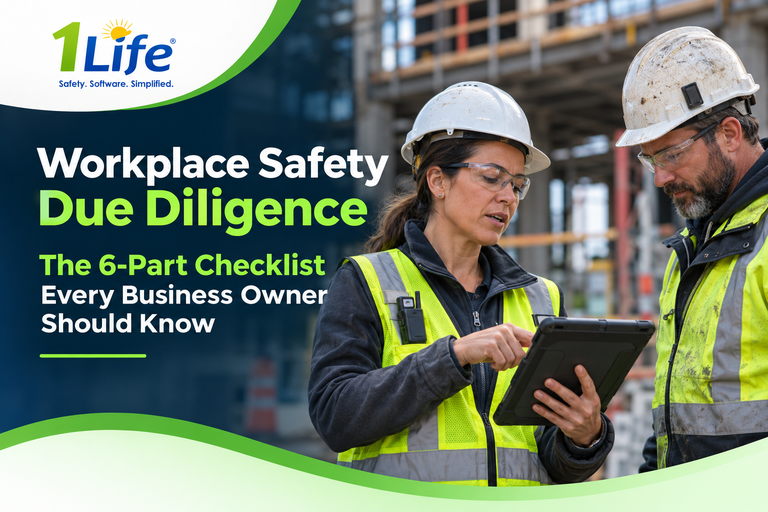
Workplace Safety Due Diligence: The 6-Part Checklist Every Business Owner Should Know
When something goes wrong, the devil is in the details. And those details matter.
Imagine a crane drops a load on your jobsite. Fortunately, nobody is injured.
But a workplace safety regulator investigates.
Was the equipment inspected? Was the operator trained and competent? Was there a safe lifting procedure? Had similar hazards been reported? Were corrective actions completed?
And can your company prove it?
A serious injury isn’t necessary for a company to face safety charges or prosecution. A dangerous near miss or unsafe condition can trigger enforcement action when workplace safety laws have been violated.
For owners, executives and safety leaders, due diligence isn’t simply about having a safety manual or completing forms.
It’s about having an effective safety management system—and being able to demonstrate that it works.
What Is Legal and Moral Due Diligence?
Legal due diligence means taking every precaution reasonable in the circumstances to protect workers, comply with applicable workplace safety laws and demonstrate those precautions when challenged.
Moral due diligence means knowing you’ve done everything reasonably possible to protect your people—not simply because legislation requires it, but because it’s the right thing to do.
In Canada, many workplace safety offences involve a reverse onus for the due diligence defence. Once the prosecution proves the elements of an offence, the employer may have to demonstrate that reasonable precautions were taken. The precise legal requirements vary by jurisdiction.
The practical question: If a regulator arrived tomorrow, could your company demonstrate due diligence?
The 1Life Six-Part Workplace Safety Due Diligence Checklist
These six management practices provide a practical framework for assessing whether your safety system is established, implemented and working.
- Policies and Procedures — Have You Established Clear Standards?
- Safety policies reflect applicable legislation and actual workplace hazards.
- Safe work procedures address your highest-risk tasks.
- Workers have access to current procedures.
- Procedures are reviewed when work, equipment or risks change.
Why it matters: Written standards are the foundation of due diligence—but only when they’re appropriate and actually implemented.
- Hazard Identification and Control — Are You Closing the Loop?
- Critical tasks and significant hazards have been identified and assessed.
- Workers can easily report hazards and near misses.
- Corrective actions are assigned to accountable individuals.
- Outstanding actions are tracked, completed and verified.
Why it matters: A worker reports a defective lifting sling. The report is completed, but the corrective action gets buried in a digital form. Two weeks later, a load drops.
The question isn’t whether the company had a reporting system. It’s whether the company acted on what it knew.
- Training and Supervision — Can You Demonstrate Competency?
- Workers receive appropriate orientations and task-specific training.
- Training plans identify requirements for each role.
- Practical training and competency verification are completed where appropriate.
- Supervisors verify that safe work procedures are followed.
Why it matters: A signed training attendance sheet doesn’t necessarily establish that someone can perform a task safely.
Can you demonstrate that workers received the procedures, understood the hazards, received practical instruction and were appropriately supervised?
- Measurement — Are You Verifying That Your System Works?
- Workplace and jobsite inspections are completed.
- Supervisors verify compliance with critical safety procedures.
- Leading indicators, including hazards and corrective actions, are monitored.
- Incidents, near misses and audit findings lead to improvements.
Why it matters: Inspections and reports have limited value unless management reviews the findings and ensures appropriate action is taken.
- Enforcement — Are Safety Standards Consistently Applied?
- Safety expectations and responsibilities are clearly communicated.
- Supervisors monitor and address unsafe practices.
- Coaching, retraining and corrective measures are documented.
- Management holds supervisors accountable for safety performance.
Why it matters: Having safety rules is one thing. Consistently ensuring they’re followed is another.
- Documentation — Can You Produce the Evidence?
- Current policies, procedures and hazard assessments are maintained.
- Training, practical instruction and competency records are available.
- Inspections, investigations and corrective actions are documented.
- Records can be retrieved quickly when required.
Why it matters: Your company may have taken reasonable precautions, but incomplete records can make demonstrating those precautions much more difficult.
Documentation doesn’t create due diligence. It helps prove what your company actually did
Why the Details of Your Safety Management Software Matter
Many safety software platforms make it easy to complete a form.
But completing a form and managing a safety system are two very different things.
What happens after a worker reports a hazard?
Does the information reach the supervisor? Is corrective action assigned? Can management see what’s outstanding? Is completion verified?
Or does the report simply disappear into hundreds of completed forms?
These details matter.
That’s why 1Life Safety Software is designed around the processes that make a safety management system work:
- Clear standards: Current policies, procedures and critical task requirements.
- Accountability: Worker-to-supervisor-to-management workflows supporting the Internal Responsibility System.
- Corrective action management: Visible, assigned and tracked actions—not issues buried inside forms.
- Training and competency: Training plans, course records and documented instruction.
- Management oversight: Inspections, leading indicators and visibility into outstanding risks.
- Reliable documentation: Organized records that help demonstrate what was done, by whom and when.
The goal isn’t simply to digitize safety paperwork. It’s to make safety management more effective, accountable and verifiable
The Executive Due Diligence Test
Ask yourself three questions:
- Could we demonstrate that our highest-risk work is being appropriately managed?
- Could we show that workers are trained, supervisors are accountable and reported hazards are being corrected?
- Could we quickly produce the evidence of the precautions we’ve taken?
If the answers aren’t clear, it’s time to review your safety management system.
The Bottom Line
Legal due diligence is about taking reasonable precautions and being able to demonstrate them.
Moral due diligence is about knowing you did everything reasonably possible to protect the people who depend on your leadership.
Both require more than good intentions, written policies or completed forms.
They require a safety management system that works—every day, across every jobsite, with clear responsibilities and consistent follow-through.
The best time to establish due diligence is long before you ever need to prove it.
That’s why 1Life Safety Software is built around the details that matter.
Safety. Software. Simplified.
About the Author: Theo Heineman, CRSP, CHSC, is CEO of 1Life Workplace Safety Solutions Ltd. With more than 20 years of workplace safety consulting experience, she helps organizations build practical, accountable safety management systems that support legal and moral due diligence.
Note: This article provides general safety management information. Legal requirements and due diligence defences vary by jurisdiction.